







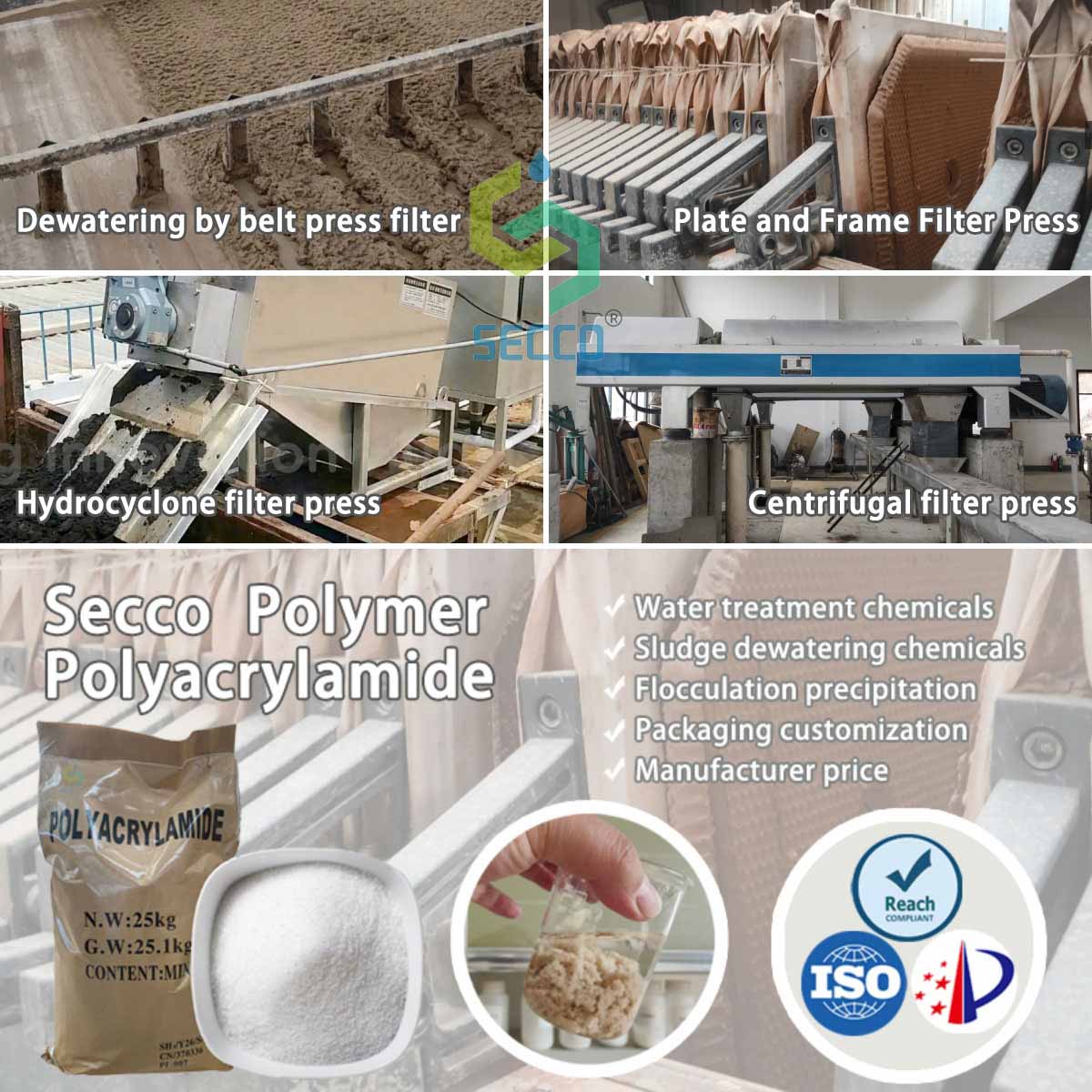
I. Core Functions of Polyacrylamide in Sludge Dewatering
Polyacrylamide (PAM) flocculant (conditioner) in dewatering sludge, significantly improving dewatering efficiency. Mechanisms eius actionis duos aspectos primos includent:
Charge Neutralization — Corpus charged in catenis molecularis PAM neutraliserunt cargas negativas super superficies particularum pulchritudinis, repulsionem electrostaticam reducentem et aggregationem particularum pulchritudinis promontem.
Adsorption Bridging — Calcinae moleculae longae PAM formant "pontes" inter multiplicas particulas pulchras, particulas pulchras dispersas connectant in maximas, densores flores. Procedus hoc effectivus liberat aquam inter particulas pulcherrimas, subsequente deaquationem mechanicalem efficientem facientem et significantem reducentem continentiam moisturiae et voluntatem libi pulcherrimae.
In praecepto, Cationic Polyacrylamide (CPAM) est typum saepe ad dewatendum pulcherrimam, particular ad pulcherrimam municipal is divitis organici. However, the specific selection depends on sludge characteristics (such as charge properties, organic matter content, and solid content) and the type of dewatering equipment.
II. PAM Selection Guide for Four Types of Sludge Dewatering Equipment
Belt Filter Press
Belt filter presses achieve solid-liquid separation through gravity drainage and mechanical squeezing, and have relatively high requirements for PAM, needing to form large and compact flocs.
Selection Recommendations: Typically use Cationic Polyacrylamide (CPAM) with an ionicity of 30%–50% and a molecular weight of 8–15 million. When flocculation effects are similar, products with lower molecular weight and higher ionicity are preferred — high molecular weight produces overly large flocs with higher moisture content, which hinders subsequent squeezing and may cause "sludge run-off".
Functio: Enhancet pulchritudinem in zona drainage gravitationis et meliora faciendum liborum sub pressione.
Common Issues: If dewatering results are unsatisfactory, besides checking the chemical type, preparation concentration, and dosage, also check whether the cinematographic speed is too fast (resulting in insufficient dewatering time) or whether the filter cloth tension is appropriate.
Typical Cake Moisture Content: 75%–85%.
Plate & Frame Filter Press
Filtros Plate et Frame presses rely on high-pressure pumps to feed sludge in sealed chambers, where filtration through filter cloths achieves dewatering. This equipment has the lowest requirements for PAM.
Selection Recommendations: Quousque flocculatio potest facere, libus pigri generis prodicere potest. Produkti recommendati sunt low-ionicity cationic PAM (10%–30%) or non-ionic PAM (for acidic sludge), with a molecular weight of 5–10 million. Plate et frame presses should use PAM with moderate viscosity — excessive viscosity can cause filter clothing adhesion, affecting dewatering performance and making clothing quite troublesome. In aliis cases, inorganic flocculants such as polyaluminum chloride (PAC) may also be used in combination with PAM.
Function: Reduces filtrate turbidity and increases solids content in the cake.
Precautions: Overdosing PAM can cause filter cloth adhesion, affecting dewatering effectiveness. Dewatering efficiency is also closely related to feed time, holding pressure, and other operational parameters.
Content of Cake Moisture Typical: 60%–70% — the best dewatering performance among the four equipment types.
Screw Press
Screw presses achieve dewatering through the squeezing action between the screw shaft and static/dynamic rings, requiring PAM to form densely compacted flocs.
Selection Recommendations: Must use medium-ionicity cationic PAM (20%–40%) with a molecular weight of 6–12 million. Typical recommended parameters are molecular weight above 10 million and ionicity above 40%. Higher ionicity provides better permeability and superior dewatering results.
Functio: Preveret effusionem particularum pulchrarum et reducit consummationem energiae equipmentorum.
Precisiones: Prius manum pulseris utilizatis, PAM oportet donare ut separationem pulseris aquae possit antequam comedere in machinam pro pulsere.
Content of Cake Moisture Typical: 85%–95%.
Centrifuge (Decanter Centrifuge)
Centrifuges rotationem altam velocitatem utilizat ut fortem centrifugalem pro separatione liquidi solidi generat, et habent maxima necessitates PAM.
Recommendationes seleccionis: Ionisitatis cationis PAM (40%–60%) cum pondus molecularis 10–15 milionum utilis est. Ionicity should be above 50%. Chemica oportet pulcherrimam celeriter formare magnas et compactas flores resistere fortibus sterilis inter centrifugam.
Functio: Accelerat velocitatem separationis liquidae solidae et reducet turbiditatem centrae.
Key Points: Dosage chemicalis accurately matches to the feed sludge volume to ensure optimal treatment results and prevent equipment malfunctions.
Content of Cake Moisture Typical: 80%–85%.
III. Summary of Selection Considerations
Pro eligere adequatum PAM pro vasa dewateringa vestra, recommendamus sequenti hoc approximum:
Identify Sludge Characteristics: Understand the sludge source (municipal/industrial), charge properties, organic matter content, and solids content — this is the foundation for selection.
Match Equipment Requirements: Different equipment has different requirements for floc size, compactness, and formation speed — belt filter presses and centrifuges require high molecular weight, shear-resistant PAM; Praecipientia et diagramma ad productiones low-ionicity suitae sunt.
Conduct Jar Tests: After theoretical selection, be sure to verify and determine the optimal PAM type and dosage through jar tests. Dosage Typica 0.2–0.6 kg per tonnam solidorum sicorum est.
Preparatio et Dosing propria: Concentratio sollemnitatis PAM normale 0,1%–0,3%, evadere excessive stirritionem, quam causam polymera degradationem potest.
Henan SECCO Environmental Protection Technology Co., Ltd. dedicatus est ad R&D. D, productio, et venditio polyacrylamide et alterum aquarum medicamentorum chemicalorum. The company's main products include cationic, anionic, and non-ionic polyacrylamide and other polymer flocculants. We provide complete sewage flocculation treatment solutions adjusted to different application scenarios. If you have specific sludge types or on-site conditions requiring consultation, please feel free to contact us for more targeted selection recommendations.
Si volueritis ad produktos nostros aut habere quaestiones, implete formam inferiorem, quaeso. We will contact you immediately after receiving it. Thank you for your choice.

Tel:+86 18703633076
Email: secco@hnsecco.com
WhatsApp:8618703633076
 Polish
 Russian
 French
 UAE
UAE farsi
farsi belarusian
 Danish
 German
 Filipino
 Finnish
 Sanskrit
 Korean
 Dutch
Dutch Haitian
 Kyrgyz
 galician
 Czech
Czech Latin
Latin Lao
Lao Romanian
 Lingala
 Luganda
 Luganda
 Kinyarwanda
 Lithuanian
 Malay
Malay Bur
Bur Marathi
 Macedonian
 Bengali
 Norwegian
 Nepali
 Portuguese
 Japanese
 Swedish
 Serbian
 Slovak
 Slovenian
 Somali
 Thai
Thai Shierqi
 Ukrainian
 Welsh
Welsh Greek
Greek Hungarian
 Hawaiian
 Hindi
Hindi Indonesian
 Italian
 Vietnamese