







Oily wastewater is one of the most challenging environmental issues in petroleum extraction, refining, machining, and other industrial sectors. Unlike free oil, which can be removed by simple gravity separation, emulsed oil exists as micron- or even nanometre-sized droplets stable dispersed in the aqueous phase. These droplets carry negative surface charges and form a robust double layer electric, making them resistant to conventional physical treatments. The situation becomes even more complex in tertiary oil recovery, where large amounts of anionic polyacrylamide (HPAM) are injected as a flooding agent and remain in the produced water. Hoc non solum viscositatem aquae magnificat, sed etiam plus stabilit emulsionem olei-aquae, multiplicans difficultatem separationis.
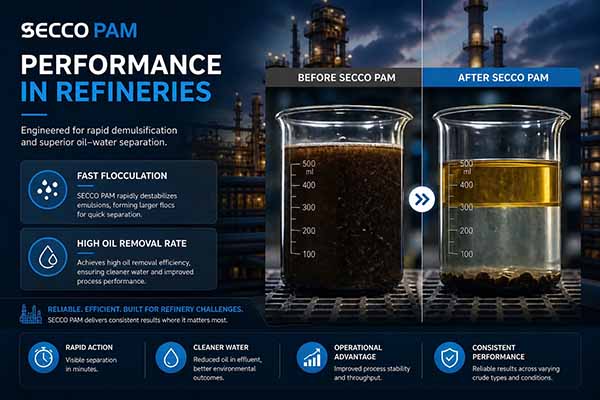
Faced with this challenge, polyacrylamide (PAM) has become an indispensable core agent in oily wastewater treatment, owing to its unique physicochemical properties.
1. Mechanism of Action: Destabilizing the Oil-Water System at the Molecular Level
The oil‑water separation function of PAM is built upon the synergistic action of multiple mechanisms.
Primus est carga neutralizatio. Emulsificata petroleum pelliculae in petroleo wastewater normale negativas cargas portant. Cationic polyacrylamide (CPAM), with its positive charges, effectively neutralizes the negative charges on the droplet surfaces, compresses the electric double layer, and destabilises the emulsion, allowing droplets to coalesce. Molecular dynamics simulations have demonstrated that CPAM exhibit significantly better adsorption on oil droplets than anionic or non-ionic PAM.
Secunda adsorptio bridge est. Calcinae molekulae longae PAM similes "concussi" faciunt, qui simul multiplicas lapides olei et particulas suspendentes adsorbent, connectant illos per effectos bridgendum magnos flores formare. Studies show that when the molecular weight and dosage of PAM are kept in an optimal range, the flocculation effect far exceeds any negative impact from increased viscosity.
Tertia interactione hydrophobica est. Modificatus PAM portantes grupos hydrophobicos potest forte interacti cum moleculabus olei per fortitudines hydrophobicis, ultra adorptionem ad pilotas olei elevare. Recentes progressi in hydrophobically modificati nano-cationic polyacrylamide promissae resultatibus monstraverunt, magnificant hydraulic diameter flotarum ab approximate 7 μm usque 16–25 μm, cum magnitudo meliora flocculationis effectivitate.
2. Precise Product Selection: Matching PAM Type to Wastewater Characteristics
Oily wastewater varies greatly in quality, so PAM selection must be adjusted accordingly.
Cationic PAM (CPAM): Suitable for wastewater with high oil content, high organic load, and acidic to neutral pH. In addition to demulsification, it effectively adsorbs organic impurities and aids subsequent sludge dewatering. High-cationic-degree products (35%–50%) are specifically designed for difficult-to-treat industrial effluents with high oil, high organics, and abundant fine suspended colloids.
Anionic PAM (APAM): Applicable to wastewater with higher levels of inorganic suspended solids and alkaline pH, enhancing floc density and setting efficiency.
Non-ionic PAM (NPAM): Ofte in systemis cum compositionibus aquae complexis et fluctuationibus pH amplius utilibus.
For deep emulsified produced water and refinery wastewater, a combined dosing scheme using both cationic and anionic PAM often yields superior results.
3. PAC + PAM Synergy: The Classic Combination That Multiplies Performance
Usus polyaluminium chloride (PAC) et PAM est unus ex classic is reagentibus in oleo wastewater treatment. The PAC acts first as an inorganic coagulant, compressing the electric double layer and neutralizing charges to cause initial destabilization of colloidal particles and oil droplets. Subseque, PAM addetur quasi flocculans organic ut ponat particulas destabilisas et petras fluctus in flos magnos, stabilis.
Research has shown that when treating fine-emulsified high-concentration oily wastewater (average oil droplet size ~440 nm, COD up to 9600 mg/L), a sequential dosage of 150 mg/L PAC under rapid mixing followed by 3 mg/L PAM under slow mixing achieves removal rates of 84.5% for oil, 57% for COD, and 96.1% for turbidity. In dissolventibus flutationibus aeris, combination of 45 mg/L PAC and 2 mg/L PAM has also been proven highly effective. The best synergistic performance is observed in the pH range of 6–8.
4. Industry Frontiers: From Traditional Flocculation to Functional Modification
Research on polyacrylamide in oil wastewater treatment continues to advance. Emulsiones cationic polyacrylamide Nanocellulose modificatae sunt excellentes effectus in petroleo offshore aquae produxerunt, levantes fluctum 96.8% in dosage iustus 4 mg/L. compositis hydrophobici nano-silica-modificatae CPAM effectionis flocculationis quasi 99% subter optimum rationem possunt. In addition, the combined use of natural tannin and cationic PAM has achieved over 90% oil removal in saline produced water, with floc formation times of less than 20 seconds.
5. Henan Secco: A Professional Provider of Flocculant Solutions
Henan Secco Environmental Technology Co., Ltd., located in the National Water Treatment Agent Industrial Cluster Zone of Gongyi City, Henan Province, is one of the earliest enterprises engaged in the development, production, and sale of water treatment flocculants. With a registered capital of RMB 10 million, the company specialises in manufacturing a full range of polyacrylamide (cationic, anionic, non‑ionic) as well as polyaluminium chloride, polyaluminium ferric chloride, polyferric sulphate, and other water treatment chemicals.
The company’s products are widely used in municipal wastewater treatment and in industries such as papermaking, metallurgy, mineral processing, oilfields, chemicals, textile printing and dyeing, pharmaceuticals, leather, and food, serving customers across more than 20 provinces and municipalities in China. Henan Secco non solutiones flocculantes alta qualitate solutiones non solutiones flocculationis ad diversos scenarios applicationis provident.
Separatio olei-aquae in trakta olei wastewater est opus in ženieriae technicamente et multo specialisae. Selecting the right flocculant type, optimizing the dosing process, and achieving precise reagent matching are key to ensuring treatment effectiveness. Henan Secco Environmental Technology Co., Ltd. remains committed to offering professional flocculant products and technical services, helping industrial clients overcome the challenges of oil wastewater treatment and achieve green, sustainable development.
Si volueritis ad produktos nostros aut habere quaestiones, implete formam inferiorem, quaeso. We will contact you immediately after receiving it. Thank you for your choice.

Tel:+86 18703633076
Email: secco@hnsecco.com
WhatsApp:8618703633076
 Polish
 Russian
 French
 UAE
UAE farsi
farsi belarusian
 Danish
 German
 Filipino
 Finnish
 Sanskrit
 Korean
 Dutch
Dutch Haitian
 Kyrgyz
 galician
 Czech
Czech Latin
Latin Lao
Lao Romanian
 Lingala
 Luganda
 Luganda
 Kinyarwanda
 Lithuanian
 Malay
Malay Bur
Bur Marathi
 Macedonian
 Bengali
 Norwegian
 Nepali
 Portuguese
 Japanese
 Swedish
 Serbian
 Slovak
 Slovenian
 Somali
 Thai
Thai Shierqi
 Ukrainian
 Welsh
Welsh Greek
Greek Hungarian
 Hawaiian
 Hindi
Hindi Indonesian
 Italian
 Vietnamese