







Fish cannery wastewater is a typical high-concentration, high-turbidity, and poorly biodegradable organic effluent from food processing. Metodos sedimentation is fisicalis tradicionalis inefficientes sunt, dum recta medicatio biologica supercargata est. As a high-performance polymericflocculant,polyacrylamidein hoc processo partita est "scavenger" et "accelerator".
I. Core Mechanisms of Action
PAM catenas moleculares ultra longas et grupos functionales suas utilizat ut tres functiones primas faciant:
Charge Neutralizatio:
Problema: Numeros particulas colloidales in aqua solitudinis, sicut proteinos et aminoscidios, cargas superficie negativas portant. They repel each other, forming a stable suspended system that resists setting.
Solutione PAM: Positive cargo grupae PAM Cationic neutraliserunt cargas negativas super haec particulas colloidales, illos destabilizantes et particulas congregantes.
Adsorption and Bridging (The most critical Mechanism):
Calcinae moleculae PAM sicut "tincti funibus". Situae eorum active simul adsorbent multiplicas particulas destabilisas, colloides et materia organica dissolventur.
Inter hunc connexionem "bridging", particula microscopica, particula difficile in aqua congregata sunt et ligata sunt simul, formantes magnas, densas et videntes "flores". In hoc processo, fata, olei et fines carnes piscium etiam colligunt et inmescentur.
Sweep Flocculation:
Quando flores magnos fixerunt, sicut retis filtrationis descendentes, particulas tenentes et dissipantes in via sua, purificantes profundum.
II. Treatment Efficiency and Advantages
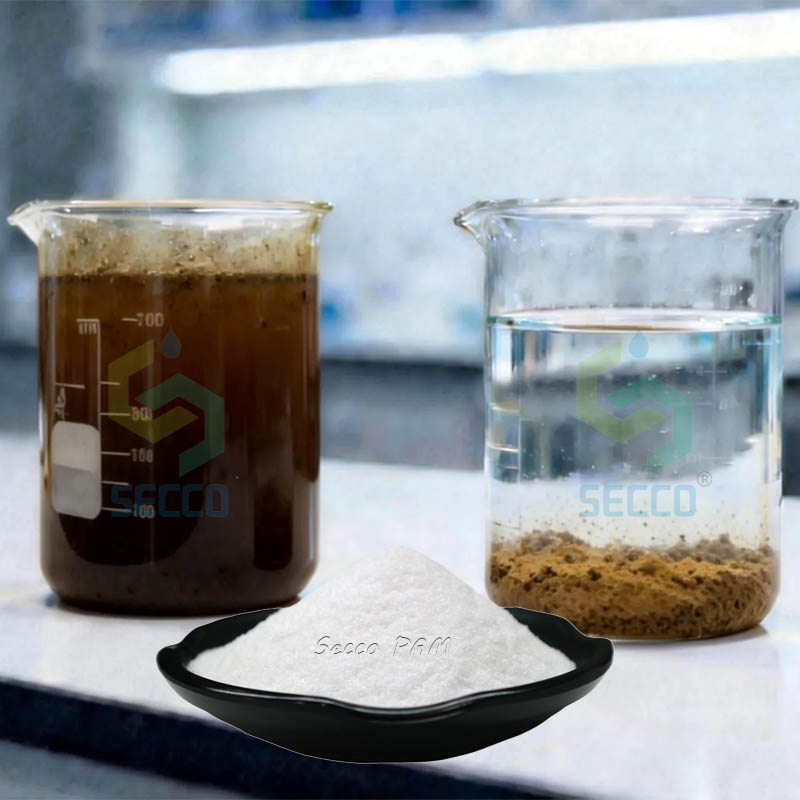
The addition of suitable PAM to fish cannery wastewater delivers the following immediate and visible results:
Highly Efficient Solid-Liquid Separation, Dramatically Reduces Turbidity and SS:
Result: Turbid wastewater separates into distinct layers within minutes, producing a clear supernatant.
Data: Suspended Solids removal rates typically exceed 90%, and turbidity reduction often reaches 95% or higher. Hoc est maximus 直观 et effectum significatum.
Effective Removal of Fats, Oils, and Colloidal Organics:
Resulta: Flocculation entraps emulsionis oleis, proteinos dissolventur, et substantias colloidales in flos pulsantibus.
Advantage: Significantly reduces the wastewater's COD and BOD, reducing the load on subsequent biological treatment units (e.g., UASB, aerobic tanks) and enhancing the stability and efficiency of the entire treatment system. Exeductione COD prima a 30% ad 60%.
Devaterabilitatem Sludge improvet:
Result a: The settled sludge (primarily organic) is denser and has a relatively lower water content.
Advantage: In the subsequent sludge dewatering stage (using filter presses, centrifuges), another dose of PAM (usually cationic) can further squeeze water from the sludge, forming firm filter cakes and significantly reducing sludge volume (by up to 70% or more), drastically cutting sludge hauling and disposal costs.
High Comprehensive Economic Benefit:
Low Dosage, High Efficiency: As a coagulant aid, PAM is highly effective at very low dosages (ppm levels).
Reduces Overall Operating Costs: By enhancing pre-treatment efficiency, it protects downstream biological units, reduces the risk of equipment clogging, and lowers power and overall chemical consumption, offering excellent cost-efficiency.
III. Claves Points for Product Selection and Application
Çünkü pislik kanseri kanalizasyonunun kompleksitesinden gelince, doğru ürün seçimi ve uygulaması önemli bir durum vardır.
Product Selection Recommendation:
Primo Choice: Cationic Polyacrylamide (CPAM). Pro alto contento colloidorum colloidorum negativo charged (proteinos, fatty acides, etc.), dual is actiones CPAM charge s neutralizationis et adsorptionis bridging maxima efficabitur.
Alternative/Coagulant Combination: For some water qualities or pre-treatment stages, Anionic Polyacrylamide can be used in combination with inorganic coagulants (e.g., PAC, Polyaluminum Chloride). The PAC is added first for charge neutralization and initial coagulation, followed by APAM for bridging and large floc formation.
Molecular Weight: Typically, medium-high to high molecular weight products are selected to ensure strong bridging capability and the formation of large, robust flocs.
Procedus aplicationis:
textum
Waste Raw → Scramma (magna solida removit) → Equalisatio Tanc (flux/carga homogenizat) → ** •Core Treatment Unit】** → Sedimentation Tank/DAF Unit → To Biological System
↓
**Flocculation Reaction Tank**
↓
**1. * Rapid Mix: Add PAC (Optional)**
↓
**2. * Slow Mix: Add PAM Solution**
Notas importantes:
Dissolution: Must be prepared using proper dissolution equipment to ensure complete hydration into a uniform colloidal solution, avoiding "fish eyes" that impair performance.
Dosing Point & Mixing: The dosing point should be in a zone with gentle mixing. Vigor agitatio tondere et dissipabunt flores formas.
Jar Testing is Critical: It is strongly recommended to conduct jar tests with the specific customer's wastewater to determine the optimal PAM type, dosage, and sequence. Aquae characteres variantur inter fabricas et etiam tempora.
conclusion
Piscibus caneribus polyacrylamide optimum additivum non est sed key chemical essential for achieving effluent compliance and reducing treatment costs. It rapidly transforms difficult to-treat, "soupy" wastewater into "clear water" and "manageable sludge," effectively unblocking the "bottleneck" of the entire treatment process.
As a manufacturer, offering free jar testing services and providing customized chemical selection and dosing proposals based on visual demonstration of results will be the most persuasive form of sales and technical support.
Si plus quaestiones habetis de manipulatione wastewater polyacrylamide, libere connectare, quaeso.Henan SeccoIn omni tempore!
Si volueritis ad produktos nostros aut habere quaestiones, implete formam inferiorem, quaeso. We will contact you immediately after receiving it. Thank you for your choice.

Tel:+86 18703633076
Email: secco@hnsecco.com
WhatsApp:8618703633076
 Polish
 Russian
 French
 UAE
UAE farsi
farsi belarusian
 Danish
 German
 Filipino
 Finnish
 Sanskrit
 Korean
 Dutch
Dutch Haitian
 Kyrgyz
 galician
 Czech
Czech Latin
Latin Lao
Lao Romanian
 Lingala
 Luganda
 Luganda
 Kinyarwanda
 Lithuanian
 Malay
Malay Bur
Bur Marathi
 Macedonian
 Bengali
 Norwegian
 Nepali
 Portuguese
 Japanese
 Swedish
 Serbian
 Slovak
 Slovenian
 Somali
 Thai
Thai Shierqi
 Ukrainian
 Welsh
Welsh Greek
Greek Hungarian
 Hawaiian
 Hindi
Hindi Indonesian
 Italian
 Vietnamese