







Textile printing and dyeing industry is a vital sector of China's economy, yet it is also a major consumer of water and a significant source of pollution. Statistics show that traditional dyeing processes consume approximately 200 liters of water per kilogram of fabric producedThe wastewater generated contains large quantities of dyes, auxiliaries, heavy metals, and organic solvents, making treatment difficult and costlyAgainst the backdrop of increasingly stringent environmental regulations and intensifying market competition, achieving a balance between efficient production and environmental protection has become a critical challenge for textile dyeing enterprises.
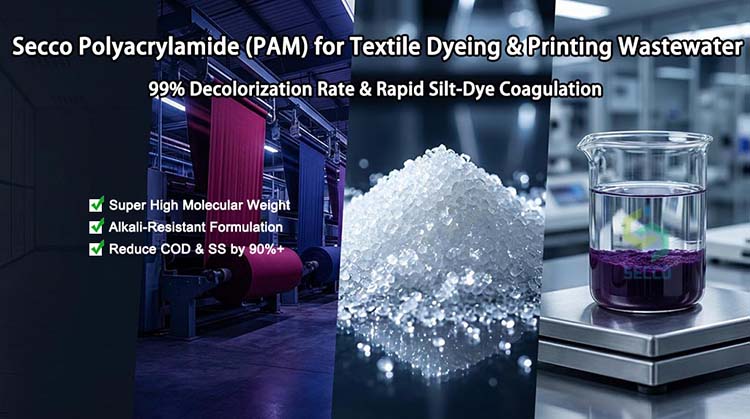
Polyacrylamide(PAM)As a water-soluble high-molecular polymer, has seen its applications in the textile printing and dying industry expanded from traditional wastewater treatment to sizg, printing, dyeing, and finishing processes, thanks to its excellent flocculation, thickening, and adhesion properties.Environmental Technology Co., Ltd., a professional supplier of wastewater treatment chemicals specializing in polyacrylamide, polyaluminum chloride, and polyferric sulfate, is committed to providing efficient and environmentally friendly chemical solutions for the dyeing industry.
During immersion and pad dyeing processes, dye migration on fabrics is often uneven, particularly during the heating stage when dyes tend to "migrate," causing side-to-center color differences, head-to-tail shade variations, or localized color spots. Polyacrylamide forms a weak cross-linking structure in the dye bath through its long molecular chains, slowing down the dye uptake rate while increasing bath viscosity, thereby inhibiting excessive dye migration.
In praecepto praecepta, fabricatio contra variationem umbrae sinistrae dextrae structa est quando cotton purum dyeing cum coloribus reactivatis 0.1% non ionic PAM (molecula pessima ~4 miliones) ad banum fartum addit. Viscosity bathae ex 1,2 mPa·s usque ad 2,5 mPa·s crevit, et differentia coloris ex 3. nivel usque ad 4.5. nivel meliora est, delevit necessitatem re-umbracionis.
Moreover, polyacrylamide improves dye distribution on fibers, resulting in more uniform dying with reduced shade variation, while forming weak bonds with dye molecules to enhance color fastness and extend fabric service life.
Traditional oxygen bleaching stabilizers predominantly use sodium silicate, which, despite its effectiveness, tends to form difficult-to-remove silicate scale on equipment and fabric surfaces, leading to silicate spots or stiff hand-feelPolyacrylamide, non-silicon bleaching stabilizer, relies on its complexation and dispersion effects on metal ions to inhibit the ineffective decomposition of hydrogen peroxideParticularly, low-molecular-weight anionic PAM (molecular weight 500,000–1,000,000) used in combination with magnesium salts delivers stable fabric whiteness after bleaching while completely eliminating silicate scaling issues.
PAM as a bleaching stabilizer also effectively prevents the formation of oxidation spots on fabric surfaces, reducing product defect rates.
In rope dyeing machine s (such as jet dyeing and airflow dyeing machines), repeated friction between fabric and the dyeing machine's inner wall and lifting rollers can easily cause abrasions and creasesPolyacrylamide forms an extremely thin hydrated lubricating film on fiber surfaces—distinct from oil-based agents, this film does not affect dye uptake but significantly reduces the dynamic friction coefficientIn rope dyeing processes, PAM forms a water film in the bath that acts as a fluid lubricant, reducing close contact between fabrics or between fabric and metal surfaces, effectively preventing surface abrasion.
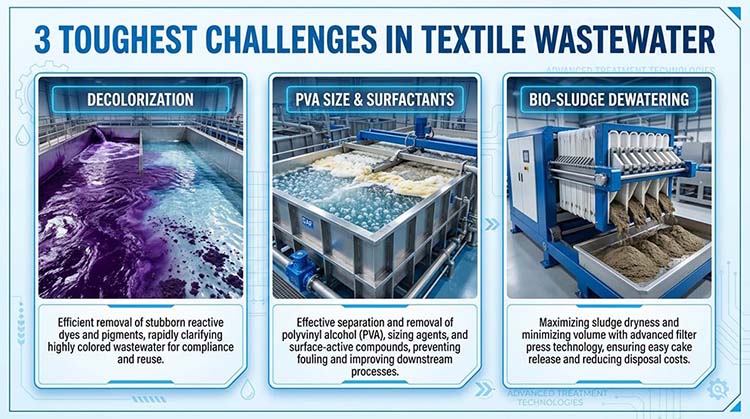
Printing and dyeing wastewater has a complex composition, containing various pollutants including disperse dyes, suspended dyes, vat dyes, and sulfur dyes, which are difficult to completely remove using traditional treatment methodsPolyacrylamide, as a highly effective organic flocculant, plays an irreplaceable role in printing and dyeing wastewater treatment.
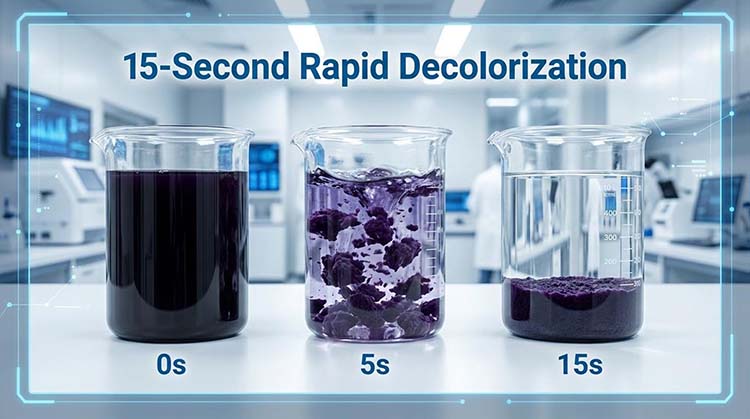
Leveraging its powerful flocculation 效果, PAM effectively removes various dye pollutants from wastewaterStudies show that PAM can achieve COD removal rates exceeding 64%, color removal rates over 96%, and turbidity removal rates up to 92% for printing and dyeing wastewater. When PAM is used in combination with in organic flocculants such as polyaluminum chloride (PAC), treatment performance is further enhanced, with organic matter removal rates improved significantly.
Polyacrylamide ligatur particibus suspendis ut magnis flores formarent, sedimentationem suam acceleratantes et auferentes solidos suspendentesIn printing and dyeing wastewater treatment, anionic PAM is primarily used for flocculation and sedimentation, while cationic PAM is mainly used for sludge dewatering—this is the industry's most standard combination.
The combination of PAM with inorganic coagulants such as PAC and polyferric sulfate creates a synergistic "inorganic + organic" treatment system. PAC/PAM composite flocculants generally achieve higher decolorization rates than PAC alone. Adding a small amount of PAM to PAC before introducing it into printing and dyeing wastewater can significantly increase COD and ammonia nitrogen removal rates by approximately 20%, while substantially reducing residual aluminum levels.
Through charge neutralization and bridging effects, PAM compresses the floc structure of sludge, reducing moisture content to below 60% and decreasing hazardous waste disposal volumes and treatment costsCationic polyacrylamide is particularly suitable for printing and dyeing sludge dewatering, effectively neutralizing charges and forming dense sludge cakes.
As a sizing and finishing agent for fabric after treatment, polyacrylamide forms a soft, anti-wrinkle, and mildew-resistant protective layer on fabric surfaces.
During the textile sizing process, PAM can be mixed with starch, cellulose derivatives, and other materials to form sizg paste that coats yarn surfaces, enhancing yarn strength and abrasion resistance while effectively reducing breakage rates. Sized yarns have smoother surfaces, reducing friction and tangling during weaving and significantly improving production efficiency. PAM's water-soluble polymer chains allow viscosity adjustment according to concentration requirements, ensuring uniform paste application on yarn surfaces while minimizing residue and reducing energy and water consumption.
As a finishing agent, PAM imparts antistatic and flame-retardant properties to fabrics, enhancing textile safety and functionality. Its strong hygroscopicity also contributes to improved fabric comfort and durability.
The application of polyacrylamide in the printing and dyeing industry not only improves product quality and environmental performance but also delivers significant economic benefits:
Costa chemica reducta: PAM can lower water treatment chemical costs by 15%–25% per ton while reducing dye waste by approximately 10%.
Consuma aquae reducta: By enhancing dyeing efficiency and improving wastewater treatment performance, PAM effectively reduces water consumption in dyeing processes.
Minus consummatio energiae: PAM application improves sedimentation efficiency, shortens subsequent dewatering processing time, and reduces confidence in mechanical dewatering equipment and energy consumption.
Different application scenarios in the textile printing and dyeing industry require appropriate PAM types:
| Programma Scenario | Mix Radio | Claves specificationes |
|---|---|---|
| Flocculation/sedimentatio dissipantur wastewater | Anionic APAM | Molecular weight 12–15 million, hydrolysis degree 15%–25% |
| High-turbidity wastewater treatment | Anionic APAM | Molecular weight 18–20 million, hydrolysis degree 20%–30% |
| Dying sludge dewater | Cationic CPAM | Ionicity 30%–50%, molecular weight 8–12 million |
| Dye leveling/bleaching stabilization | Non-ionic NPAM | Molecular weight selected based on process requirements |
In praecepto, prima testa tabulae conditur, mensuram floticam, sedimentationem, claritatem supernatantem, et alios indicatores ut optimum generem produktorum et dosage determinant..
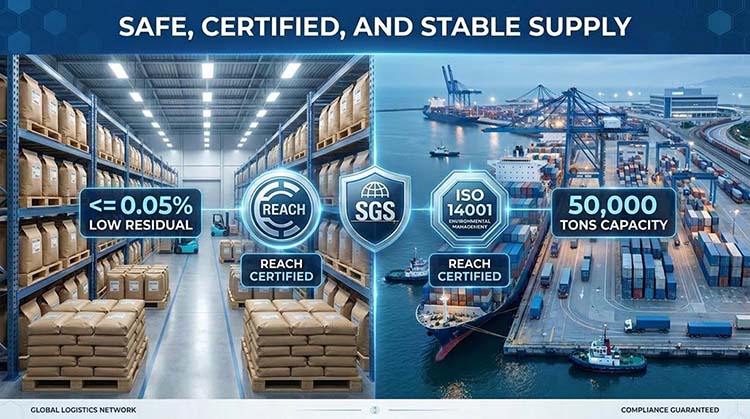
The application of polyacrylamide in the textile printing and dyeing industry has expanded from a single water treatment function to multiple dimensions including process optimization, product quality improvement, cost control, and environmental protection. As textile materials and dyeing processes continue to innovate, the application prospects for PAM will become even broader.
Henan Secco Environmental Technology Co., Ltd. specializes in the R& D and supply of polyacrylamide, polyaluminum chloride, polyferric sulfate, and other wastewater treatment chemicals, committed to providing professional and efficient water treatment and process optimization solutions for textile dyeing enterprises. Choose Secco to help your enterprise achieve the win-win goal of green production and sustainable development
Si volueritis ad produktos nostros aut habere quaestiones, implete formam inferiorem, quaeso. We will contact you immediately after receiving it. Thank you for your choice.

Tel:+86 18703633076
Email: secco@hnsecco.com
WhatsApp:8618703633076
 Polish
 Russian
 French
 UAE
UAE farsi
farsi belarusian
 Danish
 German
 Filipino
 Finnish
 Sanskrit
 Korean
 Dutch
Dutch Haitian
 Kyrgyz
 galician
 Czech
Czech Latin
Latin Lao
Lao Romanian
 Lingala
 Luganda
 Luganda
 Kinyarwanda
 Lithuanian
 Malay
Malay Bur
Bur Marathi
 Macedonian
 Bengali
 Norwegian
 Nepali
 Portuguese
 Japanese
 Swedish
 Serbian
 Slovak
 Slovenian
 Somali
 Thai
Thai Shierqi
 Ukrainian
 Welsh
Welsh Greek
Greek Hungarian
 Hawaiian
 Hindi
Hindi Indonesian
 Italian
 Vietnamese